Home › Commercial Foundations and Footings
Superior Concrete Durham constructs commercial concrete foundations and footings for projects in Durham, NC. We install grade beams, column pads, and machine foundations according to engineered designs so your structure has a reliable base.
Superior Concrete Durham provides professional commercial concrete foundation throughout Durham, NC, North Carolina and the surrounding area. Our licensed, insured crew delivers safe, clean, on-time work with a free estimate before anything begins. Call (984) 384-5856 or request your free quote.
Commercial Concrete Foundations Built for Durham Conditions
A commercial concrete foundation in Durham is not just a bigger version of a house slab. It has to support higher loads, longer spans, equipment vibration, and sometimes complicated soil conditions. Superior Concrete Durham focuses specifically on what local codes and Piedmont soils require so your building, warehouse, or retail space stays structurally sound for decades.
Our work is shaped by real Durham conditions: red clay that holds water, slope changes on older lots, and hot, humid summers that can accelerate curing if mixes and timing are not managed correctly. We work within the North Carolina Building Code and coordinate with your engineer, architect, or design-build team to pour foundations that pass inspection the first time and handle the real-world use your business demands.
If you are planning a new build, expansion, or adding heavy equipment, the right commercial concrete foundation is what protects your investment. We help you match the foundation type and footing layout to your loads, schedule, and budget, instead of forcing a one-size-fits-all solution.
How We Evaluate Your Site and Design the Foundation
The first step at Superior Concrete Durham is a site and plan review, not a quick quote from square footage alone. We look at your construction drawings, structural notes, and geotechnical report if one exists. If you do not have a soils report, we can coordinate basic soil probing, test pits, or recommend local geotechnical engineers when heavier loads or poor soil are expected.
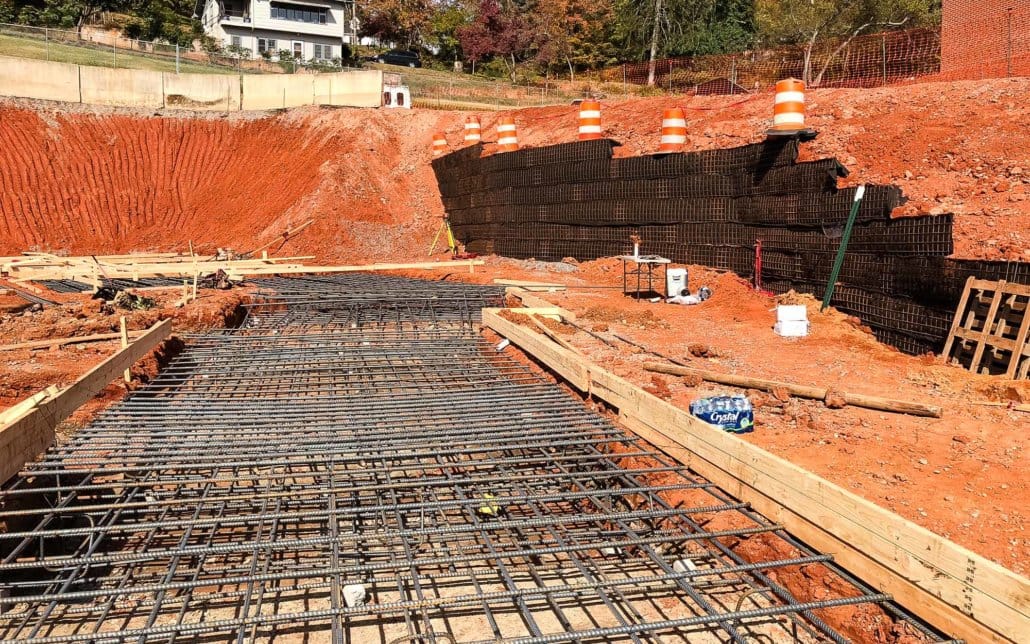
We confirm bearing capacity, groundwater concerns, and any existing fill or debris that could compromise your footings. In much of Durham, native red clay has good bearing when undisturbed, but older infill sites or former industrial properties may need undercutting and replacement stone, or wider spread footings to distribute loads.
Based on the loads and soil conditions, we determine whether you need continuous strip footings under load-bearing walls, isolated spread footings under columns, combined footings where columns are close to property lines, or a thickened edge slab for lighter structures like retail shell buildings. We also review frost depth requirements for Durham, which are modest compared to colder climates but still must be met so footing bottoms sit below the minimum depth specified by code.
What Actually Happens During Commercial Foundation and Footing Work
Once your foundation plan is set, the process is straightforward but has to be executed precisely to avoid structural issues later.
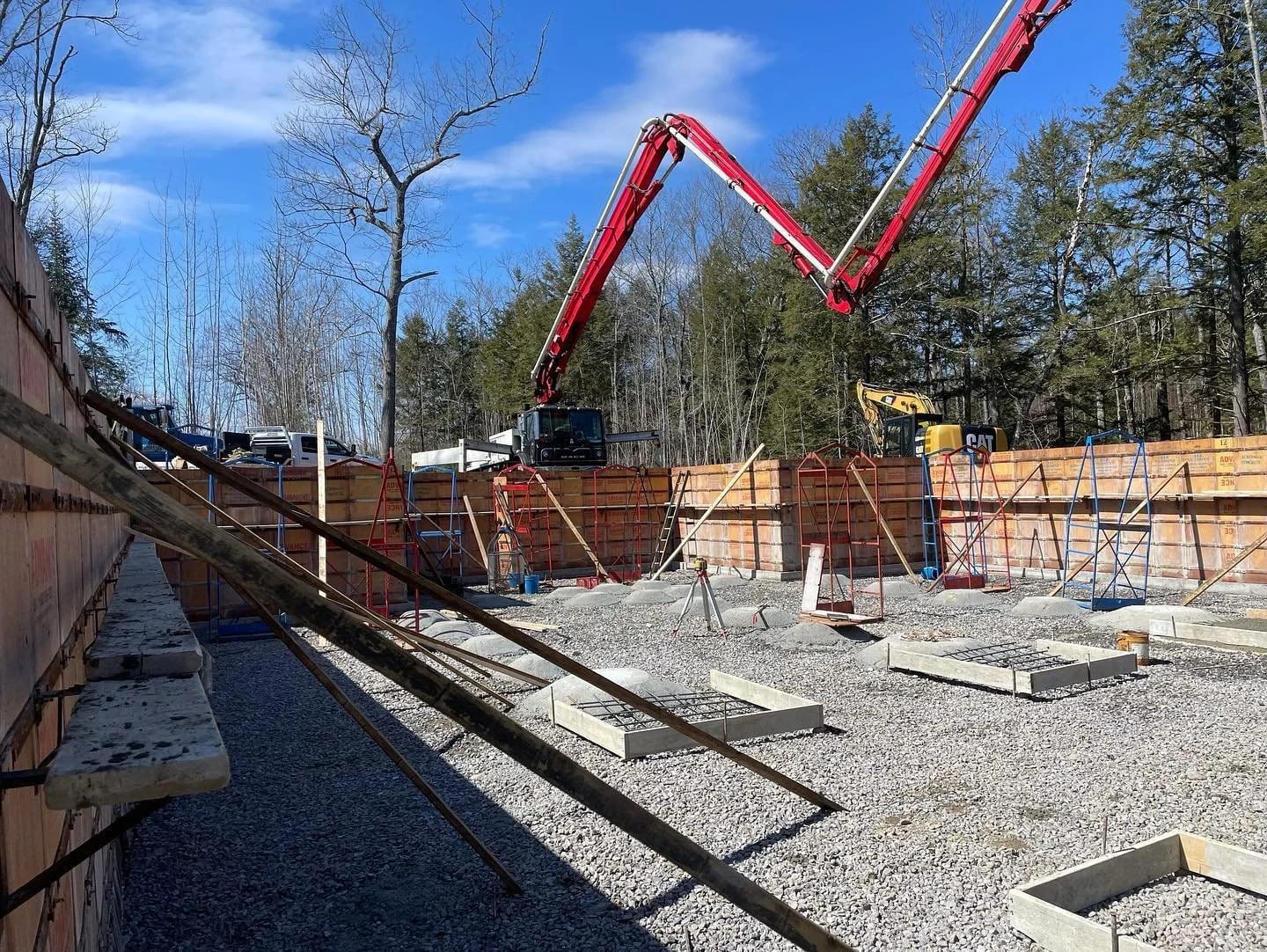
1. Layout and excavation. We use control points from your survey to mark footing locations and elevations. Excavation is done to plan depth plus room for any base stone. In Durham clay, we pay close attention to wet or pumping soils. If we see softened areas from recent rain, we either delay or undercut and replace with compacted stone so the footing does not rest on mud.
2. Subgrade preparation. We install and compact stone bases where specified, check bearing elevations, and proof roll or tamp the subgrade so it is uniform. Voids, organic material, and loose fill are removed. This is where many failures start, so we do not skip it.
3. Formwork and reinforcement. We set footing and slab edge forms to the engineer’s dimensions and elevations, braced to hold during the pour. Rebar is cut, bent, and tied per the structural details, with proper cover maintained using chairs or dobies. For machine pads, column piers, or heavily loaded areas, we often install additional dowels and stirrups to control cracking and shear.
4. Concrete placement and finishing. We order commercial mixes from local Durham batch plants suited to your design strength, usually in the 3,000 to 5,000 psi range, with admixtures for set control when summer heat is high. We place concrete using chutes, pumps, or buggies, vibrate to consolidate around rebar, then screed and bull float footing tops and slab bases. Slab-on-grade surfaces are finished to the specified flatness depending on use, such as forklift aisles or showroom floors.
5. Curing and protection. Proper curing is critical in North Carolina heat. We use curing compounds, wet curing methods, or coverings, and schedule pours to avoid the worst afternoon sun when possible. We protect early-age concrete from rapid moisture loss, accidental loading, or freezing during the rare winter cold snaps.
6. Anchor bolts and embeds. Anchor bolts for steel columns, base plates, sill plates, and any mechanical or electrical embeds are set precisely from shop drawings. We double check locations before the concrete sets to prevent costly field welding or rework later.
Foundation Types, Materials, and Options for Durham Businesses
Commercial concrete foundation work in Durham can take several forms depending on your building type and use.
Slab-on-grade foundations are common for warehouses, light industrial buildings, and retail. The slab is poured over compacted subgrade and stone, with thickened edges or interior thickened beams under load-bearing lines. This approach is efficient and cost effective when soil bearing capacity is adequate and basements are not required.
Spread and continuous footings with stem walls are used when you have masonry walls, significant elevation changes across the site, or when the building needs a crawlspace or partial basement. Footings are poured first, then stem walls are formed and poured or built with block, and the slab follows later.
Pier and grade beam systems come into play on sites with variable soils, deeper soft layers, or heavier point loads such as multi-story construction, equipment rooms, or mezzanines. In these systems, drilled piers or deeper footings carry the loads, and reinforced grade beams span between supports. While more complex, they can be cost effective compared to over-excavation on marginal soils.
We also provide specialized foundation features for commercial projects in Durham, such as thickened housekeeping pads for equipment, machine foundations with vibration isolation details, trench drains and sloped slabs for vehicle bays, and integral curbs for coolers or wash-down areas. We match concrete strengths, reinforcement, and finishing choices to the actual use, not just a generic spec.
What Drives Cost and Schedule for a Commercial Concrete Foundation
Most commercial concrete foundation costs in Durham are driven by three main factors: the soil conditions, the amount of reinforcement, and the complexity of the layout.
Unstable or unsuitable soils can require undercutting soft material, bringing in structural fill, or changing from simple spread footings to pier and grade beam systems. This is why a realistic look at the soil early can save you money later, instead of discovering problems when the excavation is already open.
Rebar quantity and detailing have a big impact on both labor and material costs. Heavier loads, seismic detailing where required, heavily loaded column lines, and thick machine pads all drive up steel use. We provide clear takeoffs so you understand what is going into your commercial concrete foundation instead of hiding costs in a lump sum.
Layout complexity also matters. Simple rectangular buildings with repetitive footing sizes pour faster and more economically. Projects with dozens of column sizes, offset grids, thickened slab strips, and multiple slab elevation changes take longer to form, place, and strip. Access for pumps or trucks in congested parts of Durham, and restrictions on pour times in busy retail or medical areas, can also affect schedule.
Weather is another real factor in this region. In summer, high heat and humidity require careful mix selection and curing plans so the concrete does not set too fast or lose strength at the surface. In winter, we plan for cold-weather practices when necessary, such as scheduling midday pours, protecting fresh concrete from freezing, and adjusting admixtures. Superior Concrete Durham works around these realities instead of pretending every pour happens on a 70-degree cloudy day.
How Superior Concrete Durham Manages Risk and Quality on Your Project
Commercial foundations fail when shortcuts are taken on preparation, layout, or curing, not just because of a bad mix. Our approach is to eliminate surprises before they become change orders or structural issues.
We verify all control points, elevations, and reference benchmarks with your surveyor or GC before excavation. We compare the foundation plan to the architectural drawings so column grids, wall lines, and door openings align. Any conflicts are raised early, not discovered after the slab is poured.
Field inspections matter for commercial concrete foundations. We coordinate with third-party special inspectors when required for footing, rebar, and concrete placement checks. Our crews expect inspections and build to that standard, which keeps your project moving through approvals.
Crack control is addressed in design and execution. We follow joint spacing and reinforcement details, cut control joints at the right time, and advise on realistic expectations. Hairline shrinkage cracks are normal in large slabs, but structural cracks that telegraph through finishes or cause trip hazards are usually avoidable if load paths, subgrade, and reinforcement are handled correctly.
Before you hire any commercial concrete contractor in Durham, ask how they handle anchor bolt placement tolerances, what curing methods they use in July and August, and how they document rebar placement. These are practical questions we answer in detail, because at Superior Concrete Durham the goal is not just to pour concrete, it is to deliver a commercial foundation and footing system your structural engineer is comfortable signing off on and your business can reliably operate on for the long term.